No student can function well without fuel for the brain. Going to school without breakfast is starting the tank on near empty. The body’s metabolism is slowed until the first meal to break the fast and it is running on reserve supply until then.
“B” could also stand for B vitamins as they help to convert the nutrients of food into energy; and there lies the next problem when developing a better student. How nutritious is the food if breakfast is eaten?
Children and teenagers require quite large amounts of nutrients to supply a growing body. Now, I didn’t say they required large amounts of kilojoules, as it is nutrients that build healthy bodies and minds. Poor choices in food quality can lead to delivery of lots of kilojoules with few nutrients. This may lead to the problem of childhood obesity.
Parents play a pivotal role in the development of their children’s eating habits. They do this in their role of parent by not giving into the child’s whims for their favourite snack foods and their position as role model when they lead by example.
The energy requirement of a teenager in growth spurt is only marginally greater than that of pre-teen children and adults but their protective nutrient (protein, vitamins and minerals) per unit of energy consumed is greater. This means a teenager requires high quality nutrient foods to maintain healthy body and mind rather than high energy foods to keep them active.
“The energy needs of teenage athletes are increased, often greatly, if heavy training and competitive sports are involved.” (Human Nutrition and Dietetics – Ninth Edition).
It is important for your child to maintain three meals a day with the addition of healthy snacks for morning and afternoon tea.
Sometimes there just doesn’t seem to be enough hours in a day to fit in what needs to be done, and there seems to be not enough weeks in the year for the school curriculum.
There are forty academic weeks to the Australian school year. This is little enough time to squeeze in the content of the curriculum. The problem is the school year is not exactly forty weeks.
There are several public holidays to be removed, and then there are “student free” days also to be taken out. If we remove the school camp that all students seem to be attending these days, sick days and time spent out of school for one reason or another (sports, museums, etc.) then we have a shortened academic year.
This all puts our teachers and students under pressure as a larger amount of acquired knowledge is squeezed into a reduced amount of attendance time.
“A” initially stood for Academic Year but now I think it should stand for “Attendance”.
So, how do you make a better student? Don’t add to the problem by reducing your student’s school attendance by removing them from school for a week-long holiday because it is more convenient.
“What then of children who come from homes where no-one hears Mother Goose, where no-one is encouraged to read signs, write scribbly letters, or play with books of any kind? What happens to them as they enter kindergarten has serious consequences for the rest of their lives – for them and for all of us.”
Though they may not be able to read by the age of five (and we should have no expectation of this) there is no reason for not sitting a child on your lap and reading to them. Let them see the words and the pictures as you read them. They may, or may not, develop at their own pace as they link the symbols of the word with the symbol of the picture. Just remember, if they don’t, they just may not yet be ready so let them be children.
Spending this quality time with your toddler is crucial to early childhood development. Andre Biemiller, a Canadian psychologist, studied the consequences of lower vocabulary levels in young children. The results of his studies indicated that children entering kindergarten in the bottom 25% of vocabulary generally remained behind the other children. By year six they were approximately three years behind their peers in vocabulary, reading and comprehension.
How to build a better student? Read to them. It’s a good start.
Are there things you can do to help your prodigy to become a person who thirsts for knowledge?
Maryanne Wolf in her book, “Proust and the Squid’ addresses this question.
“The more children are spoken to, the more they will understand oral language. The more children are read to the more they understand all the language around them, and the more developed their vocabulary becomes.”
“… many efforts to teach a child to read before four or five years of age are biologically precipitate and potentially counterproductive for many children.”
The reason for this is the myelin sheath (fatty coating around nerves to help electrical information to flow) in the angular gyrus (that part of the brain related to language, number processing, spatial cognition, memory and attention) is not sufficiently developed until five to seven years of age. It develops in all children at different rates and in girls faster than boys.
Sometimes your five-year-old is just not ready for school and your young lad may not be ready until seven years of age. By that time, they are in year two or three and maybe well behind at school. It is not that they can’t learn, it is just their brain was not ready for them to learn. They can catch up, but by this time they may need some assistance.
In his book “How Language Works” David Crystal discusses the possible effect computer-mediated communication (CMC) has had on both spoken and written language. CMC is the written communication that takes place on the internet, emails, forums etc. David Crystal infers that CMC is not like written or spoken language.
An elementary social grace we learn at an early age is that of turn-taking when we hold a conversation and “Turn-taking is so fundamental to conversation that most people are not conscious of its significance as a means of enabling interactions to be successful.”
When we ask a question and expect an answer; or expect a complaint to be followed by an excuse or apology; even when we acknowledge the receipt of information with a “thank you” we are turn-taking. This social formality allows people to take turns when they talk and not compete to talk at once.
On the internet turn-taking is dictated by the software rather than the people involved in the conversation. It is your turn after you push the “send” button and when it is received by the other party, which could be days if they are infrequent with checking their email.
Similarly, CMC is not like traditional writing because it can lack the permanency and traditional structure. Because there is so much perceived pressure to communicate some people are happy to send their messages with typographical errors, misspellings, erratic capitalisation and lack of punctuation. It would appear the care taken to revise their writing is of little or no importance to most authors of communication.
Written language has always had problems of interpretation when compared to face-to-face conversation but no amounts of “????”; “!!!!”; or smiley emoticon on emails or Facebook will replace the quizzical look or a raised eyebrow as immediate feedback to a statement.
“Does handwriting matter? Not very much according to educators. The Common Core standards, which we have adopted in most states, call for teaching legible handwriting, but only in kindergarten and first grade. After that, the emphasis quickly shifts to proficiency on the keyboard.”
“What’s Lost as Handwriting Fades” – by Maria Konnikova
The article suggests evidence is emerging of a greater link between handwriting and learning. It appears children learn to read more quickly when they first learn to write by hand.
A 2012 study by Karin James at the Indiana University supported the association between handwriting and learning. Children who had not learned to read were presented with index cards with a letter or shape they were to reproduce. They could either:
Trace the image on a page with a dotted outline.
Draw it on a blank sheet of paper.
Type it on a computer.
A study of their brain waves as they reproduced the shape or letter showed an area of the brain, active when an adult reads and writes, was highly stimulated when the child drew the letter on a blank sheet of paper. The activation was significantly weaker through the other two processes.
Learning is a complicated process. When we reproduce letters, or anything else, by hand a plan is required before executing the action. The result is highly variable in that it will not exactly represent the original. Learning to identify variable representations is important to decoding letters when reading.
The research by Virginia Berninger, a psychologist at University of Washington, indicated that when a child who composed text by hand (either printing or cursive) “They not only consistently produced more words more quickly than they did on the keyboard, but expressed more ideas.”
There is also a suggestion of different neuropathways being developed in the brain when a child progresses on from printing to cursive writing.
Research at the University of California have reported laboratory and real-world studies of students learning better when they take notes by hand than when they type on a keyboard.
So, is it time to throw away the pen and paper and adopt the technology and the keyboard? Was it time to give up walking when we invented the car?
“Let’s look at this differently”, “I can’t see the big picture”, “See how this works?” – stand back here comes a visual learner and a future artist, builder, inventor or musician, that is if they can get through our education system.
These right hemi-sphere thinking (that’s creative thinking) students are not wired to produce written reports on the thoughts they visualise in their mind, at least not until they learn how. They think and learn in multi-dimensional images. Our education system is more geared to teach left hemi-sphere thinking auditory learners who think and learn in words rather than images.
A visual-spatial learner may be good at spelling and lousy with names, needs a quiet study time, likes colour and is good with charts, maps and diagrams. They remember pictures and are good with direction. They will always have trouble remembering verbal instructions and must learn by taking notes.
As a parent you can help by explaining a project you wish them to do by explaining why you want them to do something, because they need to see the big picture first.
by Peter Kenyon: Tutor at XtraMile Tuition Strategies
There has
been some talk of late about the school curriculum and the changes it is going
through. These changes, like any change, cause ripple effects of anxiety
on students, teachers and parents. But what are the learning expectations
of our young students?
I have
been looking at www.australiancurriculum.edu.au for some guidance just so I, as a tutor, am aware and aligned with
expectations. I would advise popping onto the website and having a
look. Meanwhile I will give a brief summary focusing on maths as this is
the area parent seek the most guidance from tutors.
Year 1
By
the end of Year One a school student is expected to know
the numbers to one hundred; skip
count by 2, 5 and 10; and be able to locate numbers on a number line. Simple addition
is accomplished by counting on, re-arranging or performing partitioning.
Fractions are introduced as they learn to recognise “1/2″ and be able to tell
the time to the half hour.
I
mentioned only a small area of the curriculum as these are the areas I see most
when a student is presented for tuition. At this stage of learning any short
coming in these areas may be made up by parents sitting down with their little
one and turn learning into some form of game. There are several aids
available from various websites and suggestions on the Australian Curriculum
site.
Year
2
If you
are a parent with a young student in Australia, then chances are you have your
mind in a muddle as to education expectations.
In
Year 1 students have mastered the numbers up to 100 and skip counting
by 2, 5 and 10. This year sees them progress even further on the number
line as they move towards recognising and placing order to the numbers to
1,000, and investigate the number sequences of 2, 3, 5 and 10. It is this
year they explore the connection between subtraction and addition.
By the
end of this year they will master reading a clock (analogue and digital) to the
quarter hour using the words “to” and “past” appropriately. They
will be able to name the months of the year in the correct order as well as the
seasons of the year. They will be able to use a calendar to find the date
and know the number of days to the month.
This is only a small amount that is on the curriculum and only relates to maths as this is the area, as a tutor, I see the most problems.
How can you help your child with their studies? Do you remember this:“Thirty days has September, April, June and November,all the rest have thirty-one days clear,except February alone which has twenty-eight daysand twenty-nine each leap year.
Year
3
“These
are the best years of your life.”, self-assuring words spruiked by many a parent and teacher to
seven-year old students who don’t need reassurance after remembering their
potty-training years. They have just cruised through the first two years
of primary school, they know all the numbers, the alphabet and can write their
name; what else is there to learn?
Year 3 is
where many young students realise their world will never be the same again.
It is during this year they discover numbers do not stop at 1,000 but
continue all the way to 10,000 and they must know their order, place value, and
be able to recognise if they are odd or even! Not only that but there
are numbers smaller than one that no-one told them about as they are introduced
to the fractions 1/2, 1/4, 1/3, and 1/5.
When
learning the multiplication table by heart for 2, 3, 5 and 10 no-one warned
them about having to manage multiplying a two-digit number by a single digit
number, without a smart phone. In fact, they are expected to develop
strategies to perform addition and subtraction in their head (mental maths).
Counting on, regrouping and partitioning are all strategies employed to
perform mental maths.
It is
during this year our students are introduced to metric measurement. I
hear very few complaints from students in our tuition centre about learning
measurements. I simply remind them that learning 1,000 metres equals one
kilometre is much easier than remembering there are 1,760 yards to a mile, 22
yards to a chain, or 16 ounces to a pound.
Yes,
there is a lot to learn in Year 3 (and this is only maths) and yes, these may
be the best years of their life because Year 5 is ahead of them, but we won’t
tell them about that yet.
It caused considerable concern when I read that the American Government dropped teaching cursive writing from the core curriculum in 2010.
They have left it up to the states to decide if it should be taught in elementary schools. Some have decided not to teach the writing and reading of cursive script. Their students are not being taught to read or write past the printed letter.
Does not
teaching how to write have repercussions other than affecting the way we
develop and record our thoughts? Is it even a concern that we become solely
dependent upon smart phones, tablets and computers for recording our words?
People may have asked the same question as the motor car replaced the bicycle or television replaced evening family interaction.
Change produces change and each alteration to our lifestyle needs to be considered for its own new path. If we haven’t looked far enough down the path before taking the first few steps, we may arrive at a destination we did not desire.
I don’t think an obese society and world environmental problem was what Henry Ford envisioned with his Model T; nor did Steve Jobs foresee family members retreating to separate rooms when he wanted to bring the world together.
What damage can possibly be caused by not teaching cursive writing to young students?
I have already encountered a young postman who has difficulty delivering handwritten letters because they used “running writing”. So, we don’t receive our mail, is that a problem these days? The fact the young man couldn’t decipher or decode the letters on the envelope is of greater concern to me.
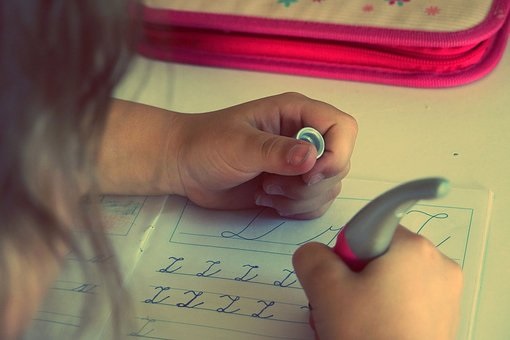
Cursive writing as with all writing requires the development of fine motor skills; skills that come with practice. The fine dexterity of finger and hand movement learned by a seven-year-old child is the same skill required to tie shoelaces, do up buttons, place a nut on a bolt or to produce a painting.
I have already begun to see within my tuition experience young students unable to control letter and number formation between 8-millimetre lines or contain them within 7-millimetre squares of a quad page. Is this a problem?
When I was in primary school, the pencil and then the pen was an important tool to my learning.
Our teachers came in early to prepare the black board with the day’s lessons. These lessons were copied into our notebooks. Maths problems were copied from the board or the textbook before being solved. Our scholastic days were filled with scribing and learning.
Our weekends required us to compose an essay, so we could practise our scribbles and improve our imagination. Even now I produced drafts for this post with pencil and paper before committing them to digital creation.
Reading, writing and arithmetic formed the foundation of independence for an individual. With all three mastered a person was armed to contribute to society, create wealth from nothing and control their destiny.
I am afraid the removal of just one may have an impact on creating an independent individual.
Those students who don’t take control of time will have time controlling them.
It is these students, particularly Secondary School student, that display symptoms of stress as the year progresses.
Students who learn how to use a diary and planner at the beginning of the year are more likely to feel relaxed as the year progresses.
Keeping a written diary or planner appears to be almost a lost science. Everything today seems to be electronic with touch pads for keying entries and apps that help to link all the diaries together and co-ordinate your appointments. This is all very impressive but is it helping your student?
At the
beginning of the term or semester your student is given their assignments and
due dates. They are also aware of sports training and events they should
be attending; forthcoming birthdays and family events; and school
activities. Showing your son or daughter how to use a diary is a valuable
life skill to pass on to them. Sitting down once a week and running
through that week’s entries helps to co-ordinate lifestyles.
Remember:
We are all given twenty-four hours a day, how you use them is up to you.




 XtraMile Tuition Strategies (North Brisbane) - 0415 049461